Sudoku - Classic Sudoku Puzzle
- 4.7
- Rating
- 10.00M
- Installs
- Free
- Price
 Analysis by App-foxy
I enjoy puzzle games that can fill five quiet minutes without demanding a noisy soundtrack, a fast reaction time, or a permanent internet connection. Sudoku - Classic Sudoku Puzzle from Guru Puzzle Game fits that mood well. It is a traditional number-placement game for Android, presented as a free download in the puzzle category, and its main appeal is still the simple one: look for patterns, make careful deductions, and complete the grid at your own pace.
After spending time with it, I see it as a practical companion rather than a flashy game. It works best when I want a focused break on a commute, during a coffee break, or at home when I would rather exercise my attention than scroll through social feeds. The experience is familiar, but that familiarity is also its strength. You can begin without learning a complicated system, and the basic rules remain easy to understand even when the harder boards become demanding.
A familiar Sudoku experience built for short sessions
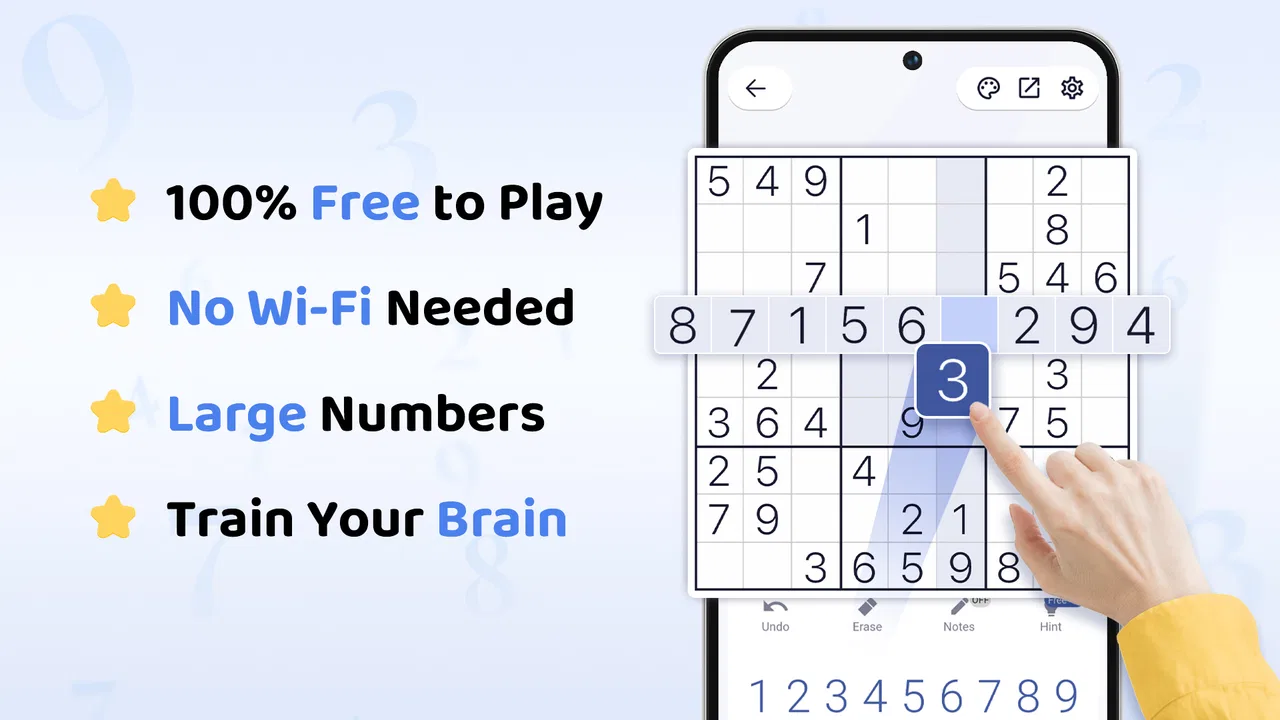
The game follows the classic Sudoku format: fill the empty squares so that each number appears correctly across the relevant rows, columns, and smaller sections. There is no need to understand a story, collect characters, or master a separate control scheme. The challenge comes entirely from reading the board and deciding which move is logically safe.
You May Also Like

 Blood Strike: 2.5 Anniversary
Blood Strike’s Loadouts Turn Every Drop Into a Tactical Gamble
A close look at Blood Strike’s custom loadouts: how fast access to signature weapons reshapes its battle royale rhythm, rewards preparation, and narrows the gap between fights.

 Pandora - Music & Podcasts
Pandora’s Music Is Easy to Start, but Harder to Recover
Pandora’s strength is its low-effort path from a seed to a station. Its weak spot is how much confidence it asks you to place in connection, setup, and quiet recovery.

 8 Ball Pool
 Is Built on Rivalries, Rematches, and Routine
A close look at the rivalries, rematches, shared routines, and unanswered safety questions that turn a quick pool match into a persistent mobile community.

 Samsung Music
’s Quiet Strength Is Playing What You Already Own
Its reach comes less from spectacle than from dependable access to a personal library. That simplicity is both the app’s strongest retention engine and its ceiling.

 AccuWeather: Weather Radar
AccuWeather Review: A Quick, Clear Forecast for Everyday Decisions
For everyday plans, the best forecast is the one you can understand quickly. AccuWeather makes rain timing, radar, and local conditions easy to act on, with a few trade-offs.

 Hill Climb Racing
Why Hill Climb Racing Still Turns Crashes Into One More Run
A tiny car, a bumpy hill and one more upgrade: Hill Climb Racing keeps resurfacing because its simple chaos makes every near-miss feel personal.
More From Our News Desk



That makes the game approachable for a wide range of players. Someone new to Sudoku can use it as a gentle introduction, while an experienced solver can open it for a quick mental workout. I especially like that the format supports different session lengths. One puzzle can become a longer concentration exercise, but a few deductions can also make a brief wait feel more purposeful.
The developer, Guru Puzzle Game, has kept the presentation centered on the board rather than surrounding it with unnecessary decoration. That is important for this type of title. When I am solving, I want the numbers, empty cells, and available controls to remain easy to read. A clean layout reduces the mental friction between spotting a possibility and entering it.
The store rating is a strong 4.7 average from around 577 thousand ratings, with roughly 8.9 thousand written reviews. Those figures suggest that the straightforward approach has attracted a large audience, although popularity alone does not make every puzzle design or interface choice perfect. The game has also passed 10 million installs, so it is clearly aimed at everyday players rather than a tiny specialist audience.
What makes the free model worth examining
The game is free to install, which makes trying it low-risk. There are in-app purchases ranging from $0.99 to $98.99 per item. That wide range is worth noticing before spending anything, especially if you are handing the device to a younger player or prefer games with completely predictable costs.
I would approach the purchase system as an optional part of the experience rather than a reason to install the game. The core attraction is solving Sudoku, not buying progress. Since the available purchase prices vary substantially, I would check the purchase screen carefully and avoid tapping through quickly. A free entry point is convenient, but it does not automatically mean every part of the surrounding monetization will suit every player.
For me, the sensible way to use this game is to install it, play several sessions, and decide whether the free experience already meets my needs. If I am only looking for occasional offline puzzles, paying may not be necessary. If I use it frequently and a purchase removes a recurring annoyance, I would still want to understand exactly what that purchase provides before confirming it.
How progress feels when the board gets difficult
Sudoku is satisfying because progress is visible in small steps. I might begin with only one obvious number, then notice that the new entry limits another row, which reveals a possibility elsewhere. The best moments do not come from guessing; they come from seeing how one correct deduction changes the structure of the whole grid.
That also creates a particular kind of pressure. A mistake near the beginning can remain hidden until much later, when the board seems impossible for reasons that are difficult to trace. I find this more mentally demanding than the relaxed appearance of the game suggests. The quiet design does not mean every session is easy.
My preferred method is to slow down whenever several cells appear possible. I scan one number at a time through the rows, columns, and sections, then mark the cells that genuinely remain available. I do not treat a tempting guess as progress. A clean deduction may feel slower, but it usually produces a more satisfying finish and makes mistakes easier to identify.
One useful habit is to stop after a wrong-looking chain rather than repeatedly forcing the same area. I return to the last assumption I made and check whether it was actually proven. This turns a frustrating board into a logic exercise. The game is at its best when I use it to practice patience, not when I rush to complete a grid simply to clear it.
Offline play and realistic everyday use
The ability to play without Wi-Fi is one of the most practical reasons to keep this particular puzzle installed. I can imagine opening it on a flight, in a waiting room, or on a train where connectivity is unreliable. It is also useful at home when I want a game that does not depend on a live connection to make a short session worthwhile.
A realistic routine for me would be a ten-minute break after lunch. I open a puzzle, solve a few straightforward placements, and stop before the session becomes tiring. On another day, I might return to the same kind of challenge in the evening and give it more attention. That flexibility is better suited to Sudoku than games that punish leaving midway or expect constant daily participation.
Offline access does not make the game ideal for everyone. If you want social competition, real-time opponents, or a large community feature set, a connected Sudoku service may be more appropriate. This title is strongest as a private, self-directed activity. Its quiet nature is a benefit for focused players, but it may feel plain to anyone who needs constant novelty.
Fairness when solving and when spending
Competitive fairness matters even in a single-player puzzle. I judge it by whether success appears to come from reasoning rather than pressure to spend. In this game, the fundamental task remains the Sudoku board itself, so a player who enjoys solving logically can treat each completed grid as a personal achievement.
Still, I would separate two questions: is the puzzle fair, and is the purchase model comfortable? A fair puzzle should give me enough information to reach a solution through deduction. A comfortable purchase model should make the cost and purpose of an optional item clear before I pay. Those are related to trust, but they are not the same thing.
The presence of purchases priced from $0.99 up to $98.99 per item means I would not let a child explore the purchase screens unsupervised. I also would not assume that the highest-priced option is necessary for normal play. My recommendation is simple: treat spending as optional, read each offer, and use the free game first. That approach protects the main reason for playing, which is solving rather than buying.
For players who care about leaderboard integrity or tournament conditions, I would choose a dedicated competitive Sudoku platform instead. This game suits personal improvement and casual completion more naturally than a serious ranked environment. Without needing to turn every session into a contest, I can focus on accuracy, patience, and gradually recognizing familiar patterns.
Small techniques that improve the experience
One technique I find valuable is to divide a session into passes. On the first pass, I look only for numbers that have one clear location in a row, column, or section. On the second, I inspect pairs and restricted candidates. This prevents me from staring randomly at the whole board and gives each scan a defined purpose.
Another useful approach is to use the game as a concentration timer without making speed the goal. I start a puzzle when I need a break from work, then stop at a natural point instead of checking the clock constantly. The game becomes a way to reset my attention. If I am tired, I choose easier reasoning rather than forcing a difficult board when my accuracy is already declining.
I also recommend treating errors as information. When a move creates contradictions, I do not immediately erase half the grid. I retrace the chain and identify the first unsupported assumption. This is a more transferable Sudoku skill than memorizing a particular pattern, and it helps preserve the calm quality that makes the game enjoyable.
A less obvious trade-off is that offline convenience can encourage longer sessions because there is no natural interruption from connection problems. That is good when I want uninterrupted focus, but not ideal if I am using the game to avoid a task. I set a personal stopping point before opening it, especially during work breaks.
Who should choose this game, and who should skip it
I would recommend it to someone who wants a familiar logic puzzle, prefers quiet gameplay, and values the ability to play offline. It is also a good fit for players who dislike reflex-based challenges. The Everyone age rating makes its basic presentation suitable for a broad audience, although spending decisions still deserve adult attention.
It is less suitable for someone seeking a story-driven experience, colorful progression, or a strong social layer. Sudoku can be repetitive by design, and no interface can remove that fundamental repetition. If you already know that you lose interest after solving a few similar grids, a collection of varied puzzle types may give you better value.
I would also hesitate to recommend it as the only tool for serious Sudoku training. A specialist app with detailed solving explanations, advanced notation, or formal competitive timing may be better for an expert who wants to analyze technique. This game is more approachable and convenient, but that simplicity may not satisfy players who want deep instruction or tournament-style measurement.
Device requirements and practical expectations
The current version is 5.4.2, and it requires Android 6.0 or later. That makes compatibility an important first check if you use an older phone or tablet. On a supported device, the basic idea should be easy to understand, but the quality of any puzzle session still depends on screen readability and how comfortable the controls feel in your hand.
I would use a larger screen if I planned a long session, particularly if small numbers are tiring to read. A phone is more convenient for waiting rooms and travel, while a tablet can make the board easier to inspect. The game’s offline character favors a device that is already charged and available, so it works nicely as a dependable backup for moments when other entertainment is inconvenient.
One thing I would not do is install it expecting the game to replace a paper Sudoku book in every respect. Paper gives me complete control over marks and can feel more deliberate. The app is more convenient, easier to carry, and less wasteful for repeated sessions, but some players will still prefer writing by hand. The better choice depends on whether portability or tactile simplicity matters more to you.
What remains important to check before spending
The free download answers the first practical question: can I try the puzzle experience without paying at the start? The purchase range answers a second question: could optional spending become significant? I would keep those points separate. A game can be enjoyable for free while still requiring careful attention around higher-priced items.
I would also decide what I want from the app before opening any purchase screen. If my goal is occasional offline solving, I would probably stop at the free experience unless an optional item clearly solves a problem I actually have. If my goal is daily practice, I would compare the convenience of this title with a paid Sudoku app that offers a simpler one-time model, where available.
That comparison is not an accusation against this game; it is simply good buying discipline. The listed purchase range is enough to justify reading before tapping, but not enough to conclude that spending is required. My trust comes from keeping the decision in my hands and refusing to treat an optional offer as part of the puzzle’s basic rules.
My final view after using it as a daily puzzle
Sudoku - Classic Sudoku Puzzle succeeds because it understands the appeal of a focused number puzzle. It is free to start, supports offline sessions, and comes from Guru Puzzle Game with a large existing audience. The format is familiar enough for beginners and flexible enough for experienced solvers who simply want a board available whenever they have a few quiet minutes.
My main reservation is not about Sudoku itself but about expectations. This is not the right choice if you need a rich story, a social competition system, or advanced coaching. I would also approach the in-app purchases carefully because the available items span from $0.99 to $98.99. That does not prevent me from enjoying the game, but it does make deliberate spending important.
Overall, I would recommend installing it to anyone who wants a straightforward offline puzzle and is comfortable treating the purchase options as optional. I like it most when I play slowly, use deduction instead of guesses, and let a single completed grid be enough for the session. The strongest reason to choose it is dependable, private Sudoku practice without needing Wi-Fi; the strongest reason to look elsewhere is the lack of depth for players seeking competition, instruction, or variety beyond classic Sudoku.
For my own use, that balance is positive. I can open it during an ordinary pause, focus on a small logical problem, and put the phone away feeling that I spent the break intentionally. It is not an ambitious puzzle platform, but it does not need to be. As a free classic Sudoku game with an Everyone rating and support for Android 6.0 or later, it earns a place on my device when I want calm concentration and a clear boundary between a useful challenge and a demanding game.
FAQs for Sudoku - Classic Sudoku Puzzle
01What features does Sudoku - Classic Sudoku Puzzle offer?
Sudoku - Classic Sudoku Puzzle provides a variety of features aimed at enhancing the user experience. It includes multiple difficulty levels catering to beginners and advanced players, an intuitive interface, hints and tips for tricky puzzles, and a progress tracker. Additionally, there's an option to undo moves and save games for later, ensuring a seamless play experience.
02Is Sudoku - Classic Sudoku Puzzle free to download and play?
Yes, the app is free to download and play. However, it may offer in-app purchases for additional features or to remove ads. These purchases are optional, allowing users to enjoy the core puzzle-solving experience without any cost, while enhancing their experience if they choose to make purchases.
03How does Sudoku - Classic Sudoku Puzzle ensure user privacy and data security?
User privacy and data security are prioritized in Sudoku - Classic Sudoku Puzzle. The app collects minimal data necessary for functionality and adheres to strict privacy policies. It does not share user data with third parties without consent, ensuring a safe and secure gaming environment for all users.
04Can I play Sudoku - Classic Sudoku Puzzle without an internet connection?
Yes, Sudoku - Classic Sudoku Puzzle can be played offline, making it a perfect companion for travel or situations without internet access. The app saves your progress locally, allowing you to continue solving puzzles anytime, anywhere, without needing a network connection.
05What are the advantages and disadvantages of using Sudoku - Classic Sudoku Puzzle?
The advantages include a user-friendly interface, multiple difficulty levels, and offline play. It also offers educational benefits, such as improving logical thinking and concentration. On the downside, the free version may contain ads, which some users might find distracting. In-app purchases can enhance the experience but are not mandatory.
Pros
- Intuitive user interface enhances gameplay.
- Variety of difficulty levels for all players.
- Offline mode available for uninterrupted play.
- Daily challenges keep the game fresh.
- Hints feature aids in learning strategies.
Cons
- Contains ads that may disrupt gameplay.
- Limited customization of puzzle themes.
- No multiplayer or competitive mode options.
- Occasional lag on older devices reported.
- In-app purchases can be pricey.

Sudoku - Classic Sudoku Puzzle
Gallery